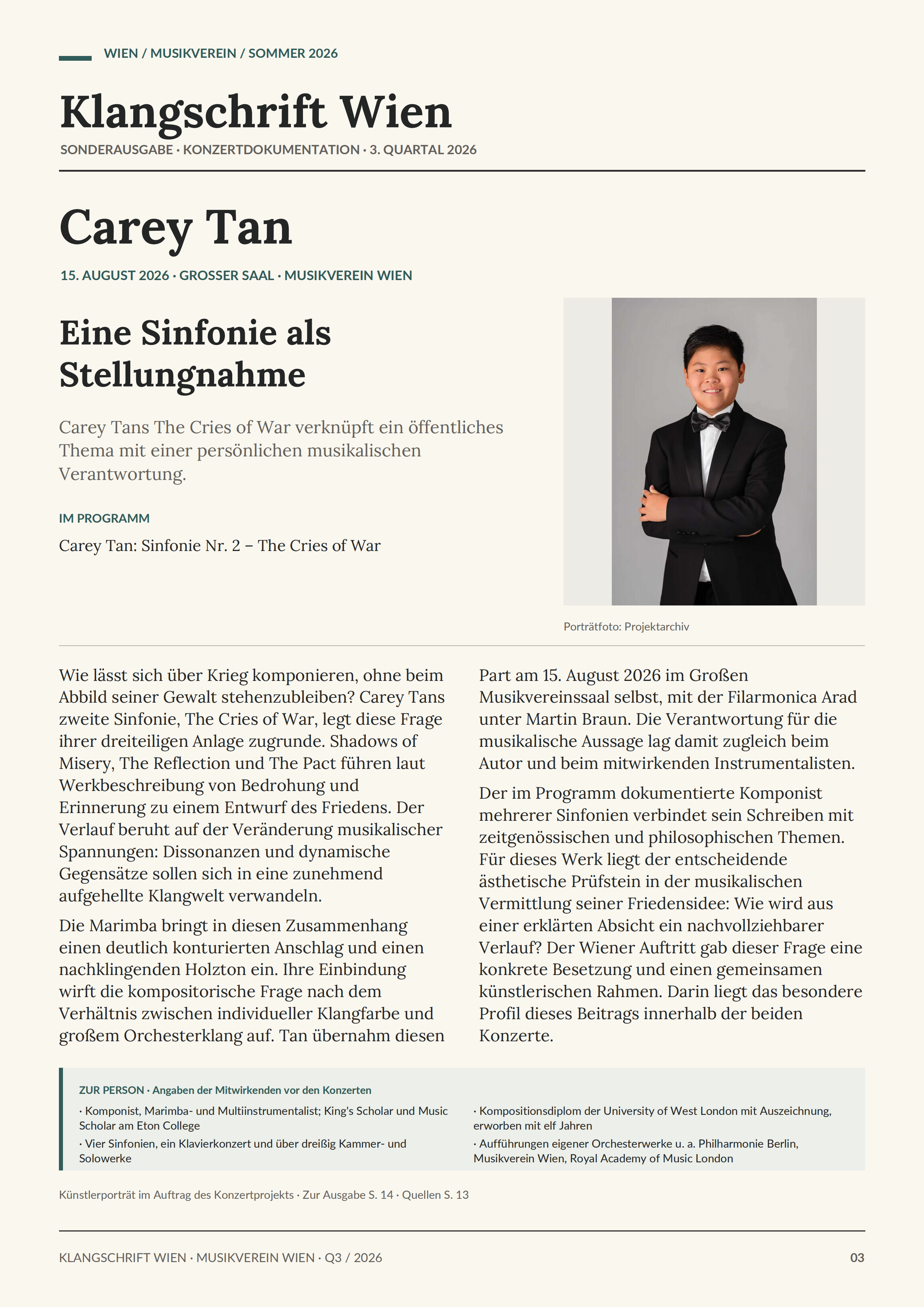





A Symphony as a Statement
Carey Tan’s Second Symphony, The Cries of War, connects the public subject of war with the personal musical responsibility of the composer.
Programme
Carey Tan: Symphony No. 2, The Cries of War
How can war be expressed through music without remaining merely a depiction of violence itself?
Carey Tan’s Second Symphony, The Cries of War, takes this question as the starting point for its three-movement structure. According to the description of the work, the three movements — I. Shadows of Misery, II. The Reflection, and III. The Pact — begin with the threat, suffering and memory created by war, and gradually move towards reflection on, and an imagining of, peace.
The development of the work is built upon a gradual transformation of musical tension. Dissonance, strong dynamic contrasts and conflicting sonorities evolve over the course of the symphony, eventually moving towards a brighter and more open sound world.
Within this musical context, the marimba introduces a clearly defined percussive character together with a resonant, lingering wooden sonority. Its presence also raises an important compositional question: how can an individual solo timbre with such a distinctive identity relate to the scale of a full symphony orchestra, retaining its own character while at the same time becoming part of the larger orchestral sound world?
On 15 August 2026, in the Golden Hall of the Vienna Musikverein, Carey Tan performed the marimba part himself with the Arad Philharmonic Orchestra, conducted by Martin Braun. The responsibility for the work’s musical statement therefore rested in two roles simultaneously: on the one hand, Carey was the creator of the work; on the other, he entered directly into the sound world he had created as one of its performing musicians.
As a composer who had already written several symphonies, Carey Tan connects his musical work with contemporary social questions and philosophical thought.
For The Cries of War, the central artistic challenge lies in whether its idea of peace can truly be communicated through the music itself.
In other words:
How can an explicitly stated idea be transformed into a musical journey that an audience can genuinely perceive and understand?
The Vienna performance gave this question a concrete musical form. Composer, solo instrument, orchestra and conductor together created the artistic context of the work, while Carey’s own participation as both composer and marimba performer gave the piece a distinctive profile within the wider concert project.
Artist Profile
Carey Tan is a composer, marimba player and multi-instrumentalist. He currently studies at Eton College, where he holds both a King’s Scholarship and a Music Scholarship.
At the time of the publication, he had completed four symphonies, one piano concerto and more than thirty chamber and solo works.
At the age of eleven, he was awarded a Diploma in Composition from the University of West London with Distinction.
His orchestral works had already been performed at major venues including the Berlin Philharmonie, the Vienna Musikverein and the Royal College of Music in London.