




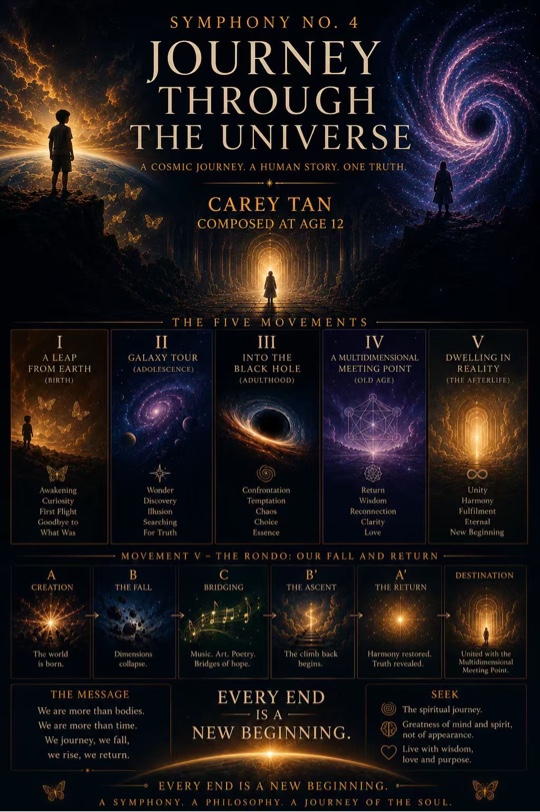
Symphony No. 4 Journey through the Universe is conceived not only as a work of music, but also as a symbolic journey through questions of existence, memory, identity and renewal, embedded within a narrative that happens to take the form of music, using orchestration to express ideas, subheadings to convey them to the audience and most importantly the music itself to connect to the fascinating and unpredictable cosmos. The listener is invited into a musical journey that reflects on identity, one's place in the world, and the shape of a human life.
At the heart of the symphony lies a central idea: "Every end is a new beginning". The piece draws on a personal imaginative framework called "Cosmological Existentialism", and in brief terms, it sees existence as beginning from a Multidimensional Meeting Point — a higher unity where physical, emotional, spiritual, natural, moral, temporal, and cosmological dimensions were once connected.
Through human limitation, failure and forgetfulness, humanity becomes separated from this original unity and enters a more fragmented state of existence, losing touch with a more complete understanding of reality.
This piece has 5 movements each with a subtitle called: ‘A Leap from Earth (Birth and Childhood)’, ‘Galaxy Tour (Adolescence)’, ‘Into the Black Hole (The Human Condition – Adulthood), ‘A Multidimensional Meeting Point (Old Age)’ and finally ‘Dwelling in Reality (The Afterlife)’. This is not just the lifecycle of the average human being, but the lifecycle of what Tan believes to be the fuller human being: not only a physical person, but a being capable of moral reflection, wisdom and connection with something greater than the self.
As you may have realised, this ‘Journey Through the Universe’ is not a real journey through the universe: The symphony imagines humanity as separated from a deeper understanding of reality, and only through spiritual and mental thought can we begin to perceive what we recognise as the ‘metaphysical’.
I. A Leap from Earth
Birth and Childhood
We are born into an imperfect world, where pressure, limitation and uncertainty can obscure the deeper dimensions of existence. Our world is a world with an end. Our world is a world with a society full of pressures. Our world is a world that values certainty over questions. But our world is also a world that connects to the cosmos: a haven of truth that can only be explored through the mind.
Butterflies in the Stomach
Our emotions are born before we are. We start by being nervous: we don’t know what our physical body in this world will be like, and we also don’t know what our spiritual journey into the multidimensional meeting point will be like. All we know is that we will be born: that is physically not spiritually. The orchestration here is thick, full of colour but also has an extremely tight rhythm: both nerve and, well, supposed beauty.
Take Off
After the nervous flutter of butterflies in the stomach, you finally take off. Everything familiar is left behind as you move towards new lives, new spiritual journeys, new connections and a deeper search for the past and for truth.
The orchestration makes the entire orchestra feel as though it is rising into flight. Repeated crescendos, increasingly rapid textures and waves of semiquaver triplets; build momentum, carrying you directly into the next section. Your lives have begun. You are born and you start the quest for truth.
Farewell Earth
And now you say goodbye to Earth. This next section, called Farewell Earth, is a very patterned section. It has lots of noticeable patterns in it. This shows you how Earth is full of patterns, full of things that stay the same. But the cosmos is a place of excitement, discovery and reaching the truth. Earth can never fully grasp the cosmos, and that is why you have to say goodbye to it just like you have to say goodbye to your physical lives: childhood is the key stage for that.
The orchestration here is big and singular in dimension, because in the symbolic world of the symphony, Earth represents the physical dimension: the world of the visible, the measurable and the familiar. It can suggest truth, but it cannot contain it fully.
Hovering in the Void
Afterwards, you reach Hovering in the Void. Not physically, but spiritually. In your mind, you are going through the cosmos — what is now known as the cosmos that we can study: the solar system, the Milky Way and beyond. That is what you are hovering through. But not the truth. You are still within illusion. Even though you have escaped the boundaries of the physical, you still haven't escaped the boundaries of the human mind.
That is why, again, this section is very patterned and stepwise. You are still within a human-made understanding of space, full of patterns, assumptions and limitations.
The orchestration here is very lively, with only one section playing at a time, while each section bounces off the others and reflects their rhythms. Everything is the same as everything else, even when it pretends to be different. There is nothing more to it than that.
A Reflection
Then you reflect. You reflect on the beginning. You reflect on the tension before you were born. You reflect on the butterflies in the stomach. Through the same rhythm, you think of the same things during childhood and before birth.
Everything is connected, but not in the most predictable way, as you will hear in the tense col legno writing in the strings, as well as the half-formed brass melodies. Nothing is clear. To reach clarity, you must first experience fear.
Cosmic Propaganda
And afterwards comes a very cheerful section called Cosmic Propaganda. You are dazzled by the beauty, vastness and wonder of the cosmos. You are dazzled by all the stars and all the lies that lie within it.
As humans, we only see the outer layer of things. For us, a stone is just a stone. The stars gathering together to form a bright light are beauty. But the deeper truth remains beyond our immediate grasp.
Disguised as a happy section, this is one of the deepest and darkest sections of the piece. Perhaps human beings can only approach truth partially. The symphony treats this limitation not as a final failure, but as part of the human condition.
As children, we tend to fall into the traps of society. But here, although you are still a child at this stage of the journey, you must understand that even as a fully grown adult, you will continue to fall into this trap: the trap of cosmic propaganda.
II. Galaxy Tour
Welcome to the galaxy. In fact, the galaxies. In fact, the lost galaxies: the lost emotional, spiritual and moral dimensions that we have abandoned along the way.
You return to them in adolescence. But to truly rediscover these hidden dimensions, you cannot simply live normally within the physical world or remain trapped within the ordinary human mind. You must think not only about this world, but about other worlds as well.
That is your galaxy tour. That is your next step towards the truth.
This stage is important. Although this movement contains moments of darkness, distortion and horror, representing the pressures and discomforts of teenage life, you must continue. The next stage will determine who you truly become and who you truly are.
Butterflies in the Heart
You always begin at an emotional point. Here comes Butterflies in the Heart.
You may notice that this movement uses tempo markings in Latin. We may appear to be moving forwards in time, but in reality, we are going backwards. We are returning to discover the roots of our universe.
This section is marked sicut pulsatio, like a heartbeat. It is rhythmically controlled. The horn melodies are not lyrical. They are not commands either. They are warnings. They tell you that the journey ahead is dangerous for your mind, for your ordinary physical mind. But they also tell you that when you complete it, you will achieve great glory, strength and honour.
The col legno battuto and quasi ricochet writing in the violins and violas expresses the same idea. It is extremely difficult to repeat these techniques at a tempo of 160, within such a tightly controlled rhythm, for such a long time. But the sound achieved at the end is deeply rewarding.
I have always believed that seven is the luckiest number in all eternity. There is no number luckier than seven. That is why, although this section may appear to be in a minor key, every phrase is seven bars long.
Farewell Milky Way
Be ready to say goodbye to the Milky Way as the next section begins: Farewell Milky Way.
The dark orchestration, fast rhythmic patterns, deep, dark tremolos in the cellos and double basses, and the tense yet grand tempo marking all carry you away from everything you know.
In this section, you truly enter the lost dimensions. After this point, nothing can be predicted. The music may travel anywhere: into any key, rhythm, tempo or instrumental colour. Nothing ahead is certain.
This is the transition from physical truth to spiritual truth, and from childhood into true adolescence. Not everyone achieves this transition. But on this journey, you must.
Hovering into the Forgotten
And then comes Section C, Hovering into the Forgotten.
You explore new galaxies and new dimensions, but these are dimensions that humanity has entered before—dimensions inhabited perhaps a thousand or two thousand years ago, but now abandoned. There is almost nothing left within them.
At first, you hear only a quiet yet tense accompaniment in the English horn and clarinet, joined by deep, dark cello melodies. Everything seems to exist outside normal rhythmic patterns. The section is in 2/2, yet the cello enters at the end of the second crotchet triplet within the bar, unsettling your sense of time.
Then, very suddenly, other instruments begin to join. The lost dimensions return. Galaxies reveal themselves to our limited and uncomprehending eyes. The oboe and flute emerge, before the bassoon leads you towards something you could never expect: a voice.
It is the voice of divine beings—creatures we can never truly know. But it is also a message telling you that you are approaching the truth.
Tremolo harmonics in the violins merge with the English horn texture, while the clarinet is gradually abandoned. This shows that some people succeed in this journey and pass through this stage, while others are left behind or return to the ordinary world.
This is a section of reflection, but also a section about what we must do to understand our inner truth.
The Roots of Our Galaxies
Afterwards comes a quieter, more solemn, but also more emotional version of the first two sections combined. This section is called The Roots of Our Galaxies.
Here, you discover that the roots of these lost dimensions are emotional roots, inner roots: roots that can only be reached through bridges such as music, visual art and poetry.
The clarinet now takes the melody that was first heard in the trumpet during the second section. The first part continues to use the seven-bar motif, while the second mirrors the earlier section, transforming the deep, dark tremolos into long, sustained minims.
This is a section of reflection, a section of thinking. It is more predictable than the sections before it, but for the first time you begin to see what truly lies inside the lost dimensions. You begin to understand not only the physical dimension—the dimension of Earth—but also the emotional dimensions, the ones that have been truly lost.
We do not really know what the physical is. We only know how to interact with it. Here, you begin to discover its true meaning. The physical is simply what can be experienced through your senses, allowing you to connect more deeply with the celestial.
This section is marked sicut anima ictum: like a soul beat. We move from rhythms like a heartbeat to the same rhythms reflecting the inner motions of our souls.
The Roots of the Hole
Then the distortion begins. This section is called The Roots of the Hole.
You are moving towards the black hole. You have not reached it yet, but you already believe you know what lies inside: something that distorts time and changes your perception of reality. You assume that this must be negative. In fact, it is something deeply positive.
The brass carries the melody, distorting it even further, while augmented and highly unusual harmonies gradually take over. The section ends with a fading C augmented-seventh chord.
If you compare this passage carefully with the later black-hole section, you will hear important differences. What you hear now is not reality itself, but the human mind’s distorted expectation of it.
A black hole is not simply distortion. It is far more than that. The black hole is the journey towards truth.
III. Into the Black Hole
What is in front of you? What do you see right now?
If you are truly on this journey, you will be looking into a black hole. On the outside, it appears to be nothing more than darkness. But within it lies the connection between our world and the world beyond the tangible and the understandable: a realm beyond ordinary understanding.
Not as we usually imagine such a realm. Not a place where everyone simply lives forever. Instead, it is the place where we encounter something greater than ourselves and finally understand how the world truly came to be.
The black hole looks frightening. It looks endless. It looks as though it could tear you apart and destroy you. But it is not. It is kind. It seems to offer healing, not by erasing suffering, but by transforming the way we understand it.
Every end is a beginning.
The black hole may appear to be the ultimate end, where gravity and light disappear forever. But in reality, it is the greatest beginning in the entire universe. Every act of greatness and every new beginning comes from its energy.
It is just like our own lives. Whenever we face a challenge, whenever we believe we have reached the end, there is always another beginning. That is the message of the metaphorical black hole.
Butterflies in the Soul
The butterflies extend beyond the stomach and beyond the heart. The agitation enters the soul. You truly feel it now. It is no longer something on the surface, but something deliberately placed within us by the flaws of existence.
Then comes the horn melody. These are our voices echoing through the void. No one can hear us. They seem to be cries for help, but in reality, they are cries expressing our desire to enter the black hole. This journey seems to have been waiting for us, yet we have never undertaken it.
The harmony reveals this hidden instinct. If you combine the first notes of the first four bars, they form a G dominant-seventh chord. The first notes of the next four bars form a C major chord. If you combine the second notes of the first four bars, they form a French augmented-sixth chord on F-sharp. The second notes of the next four bars form a radiant F dominant-seventh chord, filled with positivity and light.
This pattern continues throughout the horn melody. We do not realise that these voices are our own, or that they are declaring our desire to make this journey. We need it. We may not consciously understand that need, but instinctively, we have always known.
The horn melody is accompanied by the flute, oboe and piccolo playing harsh but quiet triplets. They represent something completely unknown to us. All the textures combine, and all our emotions exist at once.
Yet deep within them, the true human heart remains alive. Somewhere inside us, we still know that this journey is for our own good. It is a quest for truth.
The Confrontation of the Hole
Now, this is the point where the movement truly begins. This section is called The Confrontation of the Hole.
You first hear the low, dark cellos and double basses. Their notes seem to ascend, yet gradually move lower and lower. It is as though, by approaching the black hole, your reality itself is being pulled downwards.
You may also notice that almost all the tempo markings in this movement are written in Ancient Greek, except from this section onwards. That is because you are brought back into reality. You are brought back into the present. You are forced to confront the black hole from your own human perspective.
Then the violin enters with a simple yet powerful melody, surrounded by tremolos. Soon, the entire string section takes on the same rhythm as the cellos and double basses. The violins and violas begin in pizzicato, before moving into col legno. Accented notes in the cellos, double basses and first violins continue to fall lower and lower.
Then the trumpets enter with two powerful melodies. But those melodies begin to fade, just as the strings fade before them.
In the end, all that remains is a single, quiet violin. It has no power left. And neither do you.
You have no power over what now exists between you and the black hole. It may feel as though the journey has been leading you towards this point all along. Even if it frightens you, even if you want to turn back, this is something the journey asks you to face.
Event Horizon
This is a place from which even light cannot escape, where gravity becomes inescapable. To you, this truly appears to be the end. But in reality, you have only reached the first stage of truth: the first stage of encountering something beyond ordinary human understanding.
First, the clarinet, oboe and flute echo a familiar melody—the melody heard at the end of the second movement. But instead of ending on the dark C augmented-seventh chord, it now ends on a questioning E dominant-seventh chord. This leads into my favourite section of the entire piece, and one of the most emotional and touching moments of this journey.
The flute carries the main melody, while the dark cellos answer it with a countermelody. The first violins, second violins and violas play soft, clustered, con sordino tremolos through constantly changing chords, descending lower and lower. It feels as though nothing is going right.
But soon, the melody begins to rise. It climbs higher and higher. Everything begins to change. Everything begins to move towards the light.
Then have you truly entered the black hole and the depths of reality.
Here, the hairpins, crescendos and diminuendos disappear. The players are left to use their own intuition as their guide in a world beyond physical understanding. That is exactly what must happen.
This leads directly into the next section—perhaps the most powerful and familiar section of the movement, at least for certain people.
Memories: Not So Distant Perhaps
Then comes Memories Not So Distant, Perhaps. This is probably the most reflective section in the entire piece. I may have used the word "reflective" many times, but that is simply the nature of this symphony. Reflection becomes almost unavoidable in a world like this.
This section brings together my three previous symphonies and my first piano concerto, using brief fragments from each work. You are travelling backwards through time inside the black hole—not only through the universe, but through my music and my own past.
You first hear a distorted version of the grand finale of my Third Symphony. This is followed by a quieter, calmer version of a climactic passage from my Second Symphony, and then the opening of my First Piano Concerto. Finally, you hear my First Symphony.
The music remains recognisable, but everything is slowed down. The notes and harmonies are largely unchanged, yet they no longer feel the same. The black hole slows time, alters perception and forces you to question what is truly real.
Then the harp takes over in perhaps the most powerful moment of the section. It plays my very first piano piece, The Carnation Waltz. Although I did not fully understand the meaning of its title when I wrote it, it now carries a powerful significance.
A carnation is a beautiful flower. Yet flowers also reveal the limitations of physical beauty. Their beauty is profound, but temporary. We are often more attracted to what appears beautiful than to what is truly beautiful.
The melody and harmony of The Carnation Waltz remain almost the same, but on the harp they seem transformed. They are familiar, yet distorted, as though memory itself has changed them.
Through this memory, you move towards the end of the black hole. You are nearly through it, and you begin to realise that you have succeeded. The minor subdominant gives way to a radiant A major chord.
This is the meaning of the memory section. You look back at everything that came before because the black hole has changed time. It has carried you through the past, transformed your memories and brought you towards the truth.
And then, you arrive.
The End Is the Beginning
Then comes The End Is the Beginning: the central message of this entire symphony, and the key to unlocking spiritual truth.
The horns echo a melody similar to the one heard at the beginning. But now, it is transformed. What once carried tension and uncertainty has become a melody of joy and celebration.
The flutes, oboes and piccolo return with the same harsh rhythmic idea, but its harshness is now transformed into something lighter and almost comedic. What once frightened you can no longer control you.
Gradually, the horns grow into a radiant fanfare, joined by the col legno strings. The entire orchestra now celebrates your arrival.
The movement ends on a bright F major chord, crowned by a high F in the trumpets.
You have arrived at the multidimensional meeting point from which you were born. You have returned to the place where you were always destined to exist. You have completed this spiritual and metaphysical journey.
The end was never truly the end. It was the beginning.
Welcome to your new home.
IV. The Multidimensional Meeting Point
Now you are there. You have reached the multidimensional meeting point: the place where we were born, the place where we were always meant to exist.
But this is also the place we destroyed. Its physical dimension has been lost, and now it can only be reached spiritually.
Yet all the other dimensions remain: the spiritual, the mystical, the moral, and everything beyond them. They are all still there.
And do you know what else is there?
The presence of something greater than ourselves.
Here, you can finally experience complete harmony. You can live with others in true unity, and you can begin to live a better life.
In the imagined world of the symphony, this is the place towards which the journey has been moving.
It is imagined as a world of beauty, wonder, joy and wisdom.
Butterflies of Transcendence
To preserve the connection with the earlier movements, the butterflies return. But this time, they do not represent agitation. These are the butterflies of transcendence.
The section begins with a calm and freely flowing clarinet melody, marked liberamente, senza misura: freely, without measure. It is a deeply human melody, played by a solo clarinet. You have entered this new world, and only here can you begin to discover what it truly means to be human: to think, feel and act as we were always meant to.
The oboe then joins the clarinet a third higher, transforming the melody into something beautiful, connected, eternal and quiet. Gradually, other instruments enter and then fade away. These are the voices of long-lost relatives, forgotten generations and fellow human beings who have also found their way here.
You are now at peace.
You are surrounded by some of the wisest minds and souls who have ever existed: thinkers, poets, seekers and visionaries from across human history. Their presence does not overwhelm you. It quietly reminds you that wisdom is never truly lost.
Then the piccolo joins, doubling the oboe and lifting the melody into a brighter register. Finally, the piccolo, oboe and clarinet come together on a radiant F major chord.
The butterflies have changed. They are no longer signs of fear.
They are signs that you have arrived.
Staring at the Real World
Now you have arrived. You can finally take in the full grandeur of this place and begin to look back at the world you once knew.
The orchestration creates an enormous sense of space. Extremely high violins tremble at pp, while the low double basses echo them from the opposite end of the register. The cellos add calm, peaceful pizzicatos without any sense of attack.
The violins move between tightly packed and significant chords, revealing the variety of this multidimensional world. The harmony shifts between joy and mystery. The people who exist here are themselves deeply mysterious—people whom many others could never fully understand.
Soon, the music begins to move from simply arriving in this world to actually understanding it. A sequence of strange, mysterious and constantly changing chords gradually opens into beautiful harmonies: G-flat major and E-flat major. These harmonies collide, merge and finally come together, while the harp joins them and carries you forwards.
This leads into what is perhaps the most important section of the movement.
Prepare yourself.
You are about to experience the truth.
This is where you begin to discover what true beauty really is—and what comes next expresses something that could never happen in the physical world.
A Familiar Voice
Then comes a familiar voice.
It is a voice you have never physically heard, yet somehow you already know it. You have heard it within yourself. It has always been there.
This section is marked divini, meaning divine, and moves at a very slow tempo. But this is not the voice of any religion. It is the voice of something beyond ordinary human understanding: the deepest truth within existence, speaking directly to you.
The harp arpeggios are luminous and weightless. Then comes the bassoon in an unusually high register—a range rarely used, yet one that sounds unexpectedly resonant and beautiful. Its four-bar melody gradually passes into a calm and unusual horn line.
Then comes perhaps the most beautiful music in the entire piece: a D-flat major ninth moving into B-flat minor ninth, followed by a sequence of radiant harmonies.
On paper, these chords may appear dissonant. They are built from layered ninths, parallel fifths and widely spaced sonorities in the cellos, double basses, trombones, tuba, clarinets and bassoons. Yet together, they create not conflict, but completeness.
This is the voice of a truth greater than language. The melody is then echoed across different instruments, as though many voices are repeating the same message from across the multidimensional world.
Congratulations.
You have reached a moment of spiritual recognition.
The music suggests a new way of understanding the world and your place within it.
And then, you move onwards.
A Tender Meditation
Now it is time for meditation.
You bring yourself fully into the spiritual world—not into a state of physical beauty, because the physical has already been left behind, but into a state of spiritual beauty. The best way to enter this state is through calm, quiet meditation, surrounded by the wisdom of those who came before you.
This section is called A Tender Meditation.
A flute melody begins, echoed by the double bass and harp—an unusual combination that creates a sense of distance, stillness and connection. Afterwards, another melody emerges as the strings begin to join. It is tender, calm and deeply beautiful: a melody that draws you closer to the truth.
The same melody is then echoed in a different key by the brass. Earlier in the symphony, especially in the first movement, the brass often represented force. Here, it is transformed into a voice of emotion and peace.
Some listeners may also recognise a melody from the second movement. The theme from Hovering into the Forgotten returns in 4/4, played by clarinet and horn. But now it has changed. What was once tense and uncertain has become more beautiful, more open and more at peace.
Tension still returns. For two bars, the violins, cellos and double basses pull the music back towards uncertainty.
But this tension does not remain.
It opens into beauty, into truth, and into something calm yet immense—something peaceful, but also grand and expansive.
A Rise of Realm
Then comes the section called A Rise of Realm.
You are not gaining any more dimensions here, because every dimension is already present at the multidimensional meeting point. Instead, you are gaining a deeper level of spiritual truth. You are entering the realm from which existence itself emerged.
This may seem impossible or illogical from the perspective of the physical world. But in the multidimensional world, the laws of origin, time and creation are no longer limited by physical logic.
As more instruments join, the entire orchestra begins to rise through bare, skeletal intervals and triadic shapes: F, C, F, C. The material appears simple, but its meaning is profound. Gradually, all the instruments come together to create a vast, unified sound.
A D-flat major seventh enters, followed by a C-flat major chord. Finally, the section arrives on a glorious G-flat major chord, crowned by a high A-flat in the violins.
The music imagines a realm from which reality itself might have emerged. You are travelling into the ultimate reality—the one place that feels even more complete than the multidimensional meeting point.
Welcome.
And congratulations.
V. Dwelling in Reality
Now it is time for the fifth movement: Dwelling in Reality.
The final movement imagines a state of ultimate reality: a world that feels more complete, more truthful and more deeply connected than anything before it.
But before you go any further, look back.
Your journey has not been easy. It has been difficult, uncertain and demanding. Yet every challenge has led you here.
The reward is not power or knowledge alone. The reward is the ability to live in complete harmony: with others, with yourself, and with the deepest truth that exists.
So welcome.
Take a moment to look back at your journey. Look back at your life. Look back at everything you have experienced and everything you have overcome to reach this place.
This movement also reflects the afterlife—not as an ending, but as the fulfilment of everything that came before.
You have arrived.
Now, for the first time, you can truly dwell in reality.
Celestial Butterflies
And now come some further reflective thoughts.
These butterflies are similar to the butterflies you encountered in the fourth movement, but these are just a little more profound. They are butterflies that connect directly with your soul.
The piece begins with a true and familiar voice speaking to you through the music. Not speaking at you from a distance, but existing beside you. You are no longer simply listening to it from the multidimensional meeting point. You are now within the same world as this voice.
The woodwinds echo it with tenderness and calm. Their sound is full of emotion, gentleness and care. It is a voice that does not command you or frighten you. It supports you and reminds you that you are not alone.
Afterwards, the brass joins a third below each woodwind instrument. If you have sharp ears, you may notice that the melodies in the first eight bars also appeared in the earlier Divini section, where they represented a familiar presence that you had always known, even without physically hearing it.
The brass writing beneath the woodwinds represents all the support surrounding you: the support of your loved ones, the wisdom of those who came before you, and also the strength and support that you have gradually learned to give yourself.
This section does not settle clearly into a single key. It has the character of Ab major, but it continues to use major ninths and, at times, elevenths. The harmony feels open, spacious and complete without needing to resolve in an ordinary way.
Remember that you are no longer alone. The people you love, the wisdom of the past and the strength within you are all present.
This is a world in which you can fully flourish. It is a world in which you can understand who you truly are, why you have travelled so far, and what all the stages of your journey have been leading you towards.
Eternal Harmony
The next section is called Eternal Harmony.
Although the chords are not completely consonant, their dissonance creates an unexpected sense of togetherness. It is strange, but it works. The bassoons and clarinets connect with the oboes and English horns, forming a melody that feels patterned, yet also free. These instruments exist together, support one another and create a pure, beautiful sound.
Then the horns enter with a more striking melody, attempting to move towards A-flat major. The horns represent your instinct. You believe that what comes next will be delightful, positive, grand and triumphant.
But it is not.
Instead, the strings enter with calm chords, played extremely quietly.
So savour this moment.
You are living in harmony with one another and with the divine.
A Mysterious Call
The next section is called A Mysterious Call.
The voices you heard before belonged to those who had already reached this world. But this voice is different. It is the voice of the ultimate presence—the source of existence itself.
At first, it remains mysterious. Strange chords surround it, with high tremolo strings suspended above the distant sound of the double basses.
Then a quiet and unusual trumpet melody appears. The woodwinds echo it twice. As they do, the music traces the shape of a heart, and two heartbeats gradually emerge. The melody grows stronger, while the horns enter with beautiful F major chords.
Slowly, the mystery dissolves into beauty, love and everlasting support.
The music suggests a form of love or support greater than the individual self. We may not always recognise it or understand where it comes from, but it is always present.
And it is always with you
Rondo – ‘Where it all started’
Then the rondo begins.
The rondo is a classical form, but here it becomes a way of telling a story: the story of my own philosophical theory about how the world began, how humanity fell away from its original state, and how we may eventually return.
I will not reveal every detail, but I will outline the central idea.
In my theory, humanity began at a multidimensional meeting point: a state in which the physical, emotional, spiritual, moral and mystical dimensions existed together. Over time, through our own failures and choices, we lost the dimensions that mattered most and were left primarily within the physical world we now call Earth.
Perhaps we were not always as limited as we are now. Perhaps humanity once existed with a wider understanding of reality, but gradually forgot it and came to believe that the physical world was all that had ever existed.
Through a spiritual and philosophical journey, however, we may be able to return—metaphorically and mentally—to the point from which we began.
This rondo therefore explores the fall and rise of human civilisation: the loss of a fuller reality, the consequences of that loss, and the possibility of rediscovering what has been forgotten.
This is, of course, my own philosophical interpretation. I do not present it as the only explanation of the world, nor as a truth that everyone must accept. Many other profound theories exist. This is simply the one I have chosen to explore through this symphony.
I. The Rise of Our True World
The first statement of the rondo’s A section is a lively, classically styled fanfare. It represents the creation of our world.
The music begins with energetic writing for cellos, double basses, snare drum and cymbals, before expanding into the full orchestra and reaching a powerful fortissimo climax.
After this brilliance, the music suddenly withdraws into quiet woodwinds at mezzo piano, ending on a dissonant chord.
The world has been created, but it is already imperfect. That imperfection cannot be blamed entirely on any single force. It emerges through conflict, failure and the choices humanity makes within existence.
Creation is damaged.
And then the dimensions begin to fall.
II. The Fall of Dimensions
Then comes the B section: The Fall of Dimensions.
Everything moves downwards, but everything also begins to collide. The tempo gradually slows through a ritardando, while the musical line descends through the orchestra, beginning with the flute and ending in the double bass.
The dynamics also fall, moving from mezzo piano to piano with each repetition. The pitch descends as well, tone by tone, until everything begins to diminish.
One by one, the dimensions are lost. The great dimensions of the past disappear.
Finally, the music reaches a low A-sharp in the double bass.
That is where we are now: at the very bottom, with only the physical dimension remaining.
III. Music Bridging Emotions across Lost Dimensions
But there is always hope.
The lost dimensions have not disappeared completely. Music, visual art and poetry can still act as bridges between them.
This is the rondo’s C section, called Music Bridging Emotion Across Lost Dimensions.
I gave this section a slightly playful character and used string chords to explore the different emotions you, as the audience, may experience while listening to the piece.
It begins with anticipation: the feeling before the music starts, when you do not yet know what you are about to hear.
Then comes confusion. What is happening? What is this piece really about? To be honest, it is a very unusual piece.
After that comes absorption. You become drawn into the music and into its ideas.
Then comes questioning. What is real? What is not? What does this theme actually mean?
By the middle of the fourth movement, you may begin to understand the central ideas of the symphony. Some listeners, however, may still find it strange or eccentric.
Finally comes realisation. At the end of the piece, you begin to understand what the journey has truly been about.
The string chords express this progression by constantly mixing dissonance with harmony, uncertainty with clarity, and distance with connection.
IV. Spiritual Ascent
As you may know, after the C section of a rondo, the B section returns. But this is not an ordinary rondo.
This B section is closely related to the earlier one, but everything is reversed. Instead of descending from the flute to the double bass, it begins in the double bass and rises towards the flute.
This is a spiritual ascent.
The tempo increases. The pitch rises. Every element moves upwards, in direct opposition to the earlier B section. The music continues to climb by tone, becoming increasingly positive and hopeful.
This upward movement represents the journey you are experiencing now: the gradual spiritual ascent back towards the dimensions that were once lost.
And that is the returning B section.
V. Back to the Truth
Finally comes the grand finale: the return of the rondo’s A section.
It returns in a very similar form, but this time in D major, following the A dominant-seventh chord that ended the previous B section.
The structure is familiar, but the harmony begins to shift. The woodwinds move into a serious minor subdominant, followed by an E half-diminished seventh in the brass.
For a moment, the ending becomes uncertain. You may wonder: if we have reached ultimate reality, why has the music become strange again? Why does it still contain darkness?
But this is not the true ending.
The tension resolves into a radiant D major chord, crowned by a beautiful high A in the violin. Everything comes together in complete harmony.
The music leaves the listener with the sense of having glimpsed a more complete reality.
Congratulations. You have completed the journey. You have reached fortitude in both mind and spirit, and you have entered a state of unity with something greater than yourself.
You will not remain here in physical life forever. But spiritually, you have returned to the multidimensional meeting point from which you began.
And now, to conclude the entire symphony, this is its final message:
Every end is a beginning.
The symphony ends by suggesting that every ending may contain the possibility of renewal, and that true greatness lies not in appearance or desire, but in the growth of mind and spirit.
Thank you.