





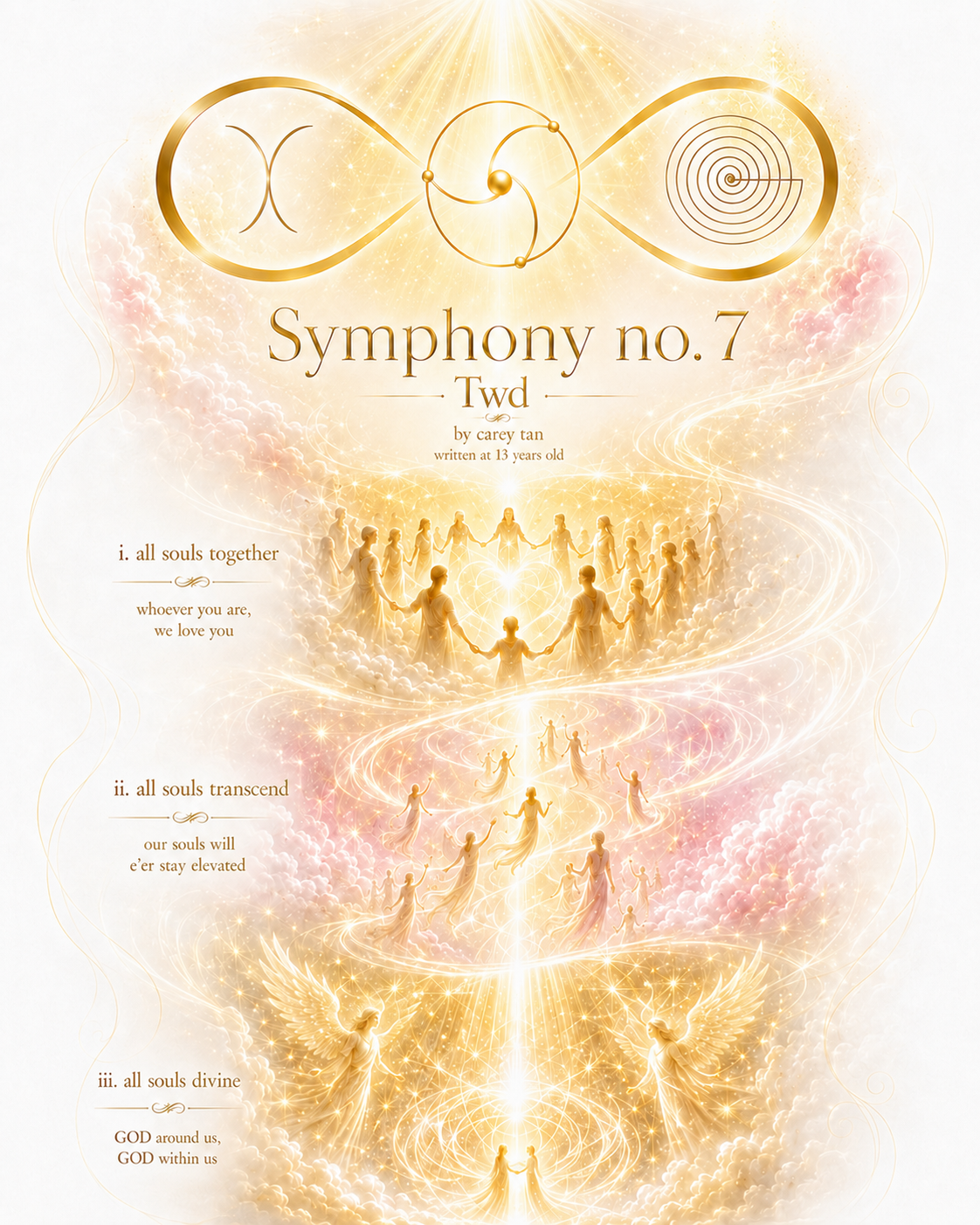
Twd is a choral symphony centered on love, harmony, life, and the Source, unfolding as a three-movement journey from human connection toward transcendence and, ultimately, a search for truth. Through All Souls Together, All Souls Transcend, and All Souls Divine, the work begins with the discovery of love between lives, gradually expands into a vision of harmony and spiritual elevation, and finally arrives at the idea that the Source is not something distant or separate from existence, but something present around us, within us, and throughout all things.
The musical language of Twd is intentionally direct and often simple, relying on clear melodies, tonal harmony, recurring triads, and voices that move together rather than pursuing complexity for its own sake. This simplicity is central to the philosophy of the work, because the symphony suggests that some of the deepest truths of existence may also be the most immediate and accessible. As the orchestra and choir gradually expand in scale, the music moves from intimate reflection toward increasingly radiant and powerful climaxes, creating a continuous progression from love, to harmony, to truth.
I. All Souls Together
The first movement explores love, connection, and the sense of lives discovering one another. It begins slowly and ethereally, with the choir alone in a warm major tonality, establishing an atmosphere of stillness and unity before the full orchestra appears. The voices sing of always being together, of love existing at the centre of the universe, and of all life existing within the Source, so that love is presented from the outset not merely as a private emotion between individuals, but as a fundamental force that connects existence itself.
As the movement develops, instruments gradually enter one by one, surrounding the choir with increasingly warm and luminous orchestral colour. The melodic writing remains clear and accessible, allowing the sound world to grow naturally rather than suddenly, as though the small space first created by the voices is slowly being illuminated. This gradual expansion leads to the first major climax of the symphony, where simple major and minor triads take on far greater emotional weight as the entire orchestra and choir begin to move together.
At the height of this section, the choir declares that love has become infinite, that all lives sing together, and that love is the first language of the universe, before arriving at the direct statement, “Whoever you are, we love you.” The idea then expands beyond individual affection into something universal, as the music presents love as a force flowing both around us and within us, with joy and wisdom coming from the Source and with humanity existing within that Source as the Source also exists within humanity.
After this large communal climax, the movement withdraws into a far more intimate and personal atmosphere. The choir seems to address a single listener, offering reassurance that whatever someone may be experiencing, and regardless of who they are or what they have done, love remains present and enduring. Woodwinds, brass, and strings gently surround these words, while the tubular bells appear as a distant and almost luminous colour rather than as a gesture of grandeur. The movement therefore begins with a vision of all lives gathering together, but ends by speaking quietly and personally to the individual, suggesting that universal love only becomes meaningful when it can also reach one person directly.
II. All Souls Transcend
The second movement begins by asking what happens when life moves beyond the boundaries of the self and becomes capable of seeing a wider form of harmony. The music opens with the harp and initially carries a slightly darker minor-key colour, after which flutes, oboes, and other woodwinds gradually join with long and flowing melodic lines. As the harmony changes, the music slowly opens into a brighter tonal space, and the entrance of the choir marks the beginning of a new stage in the symphony’s journey.
The choir sings of all things living in harmony, transcending themselves, moving toward joy, and becoming permanently united. The voices remain calm while the orchestra continues to grow beneath them, with strings creating forward motion and brass gradually adding greater weight and scale. What begins with the solitary sound of the harp eventually develops into a fully expanded orchestral landscape, preparing the listener for the principal climax of the movement.
At this climax, a broad and deeply emotional melody rises through the orchestra while the choir sings of rising, discovering beauty within ourselves, and allowing life to become elevated. Beauty is described as something that exists both within us and around us, while the Source is presented as the origin of strength and love. In this context, transcendence does not mean escaping the physical world or rejecting ordinary existence, but rather learning to perceive the beauty that was already present within ourselves, within other people, and throughout nature and the world around us.
After the climax, the music gradually softens, and the combination of choir, tubular bells, marimba, and harp creates a more reflective atmosphere in which love is described as eternal and joy as enduring. The movement eventually reaches a quieter conclusion in which humanity comes to understand the world while the world, in a poetic sense, also comes to understand humanity. Rather than ending in conquest, power, or triumph, the movement closes with recognition and awareness, suggesting that transcendence is achieved not by leaving the world behind, but by finally learning how to listen to it.
III. All Souls Divine
The third and final movement turns toward the deepest question of the symphony by asking where the Source can ultimately be found. It begins with a wistful tubular-bell melody that feels mysterious and distant while still carrying a sense of warmth and familiarity, creating the impression not of a proclamation from somewhere outside the world, but of a memory or truth that has always been present beneath the surface.
Individual voices begin to sing that the Source exists both around us and within us, and that human beings can know the Source while also being known by it. As these words unfold, the orchestra slowly awakens around the choir, with woodwinds, violins, marimba, harp, and strings answering one another in a series of musical exchanges. The different sections of the orchestra gradually begin to sound like participants in a single conversation, so that separate voices and instrumental colours are increasingly absorbed into one larger musical whole.
The music then rises toward one of the most important climaxes of the entire symphony, where a broad and radiant melody expands across the orchestra and the soprano reaches into an exceptionally high register above the choir. The text becomes increasingly direct as the voices sing that together we remain strong, together we rise, together we come to know ourselves, and together we begin to understand the grace of the Source. Yet the central statement of the movement comes immediately afterwards, when the choir insists that, above everything else, what matters most is that together we will love.
The movement then introduces one of the most unusual images in the entire work, stating that in the end the devil will no longer remain a devil, but will become a bloom. The meaning of this image is not the destruction of darkness, but its transformation, because the symphony proposes that if love can truly become infinite, then even what appears most lost, isolated, or separated from goodness may still be capable of change. This idea becomes one of the most important philosophical turning points in the work, because the final victory is not achieved through opposition or annihilation, but through transformation and reconciliation.
From this point, the music moves toward the ultimate climax of Twd, with the full orchestra forming a powerful foundation beneath the choir while the harmony remains deliberately simple and direct. Because of everything that has occurred earlier in the symphony, these simple chords now carry a much greater emotional and philosophical weight, and the choir repeatedly declares that the Source is around us, the Source is within us, and we ourselves exist within the Source.
The journey therefore arrives at the conclusion that the Source was never merely somewhere above us or waiting at the end of a distant search, because it was already present whenever lives loved one another, whenever human beings searched within themselves, and whenever harmony, beauty, confusion, growth, transcendence, and love became part of lived experience. The choir finally repeats the idea of eternity as the symphony comes to rest on a radiant major chord, bringing the work to a conclusion that no longer asks another question or continues another search, but instead leaves the listener with its central belief: love has no boundaries, all things are connected, the Source is around us and within us, and we exist within the Source for all of eternity.